
RankPilot OS Insights

Blog

Actionable resources on search growth, AI answers, content operations, and team collaboration.

Shopify vs WordPress SEO Automation Workflows: How Publishing Safeguards Should Differ

The article should answer first that Shopify and WordPress SEO automation workflows need different publishing safeguards because their publishing environments and review needs are not identical. The safest approach is to define platform-specific checks before publishing, keep the workflow answer-first, and guide readers toward supporting collection, product, or hub pages only when those pages add relevant detail.

Read article

Content QA Scorecard for AI SEO Automation: Compare Draft Quality, Review Risk, Publishing Readiness, and Visibility Signals

A Content QA Scorecard for AI SEO Automation should help reviewers decide whether an AI-assisted SEO draft should be revised, reviewed further, approved, published, or monitored. The most useful scorecard separates four dimensions: draft quality, review risk, publishing readiness, and visibility signals, so teams do not confuse a strong draft with a publish-ready asset or treat visibility data as proof of causation.

Read article

How to Build an Evidence-First Brief Template for AI SEO and GEO Content

An evidence-first brief template should start with the direct answer the content must provide, define the target snapshot as the factual boundary, separate supported facts from keywords and tone guidance, and give writers clear instructions for the article body, FAQ, internal links, comparison block, buying-guide module, meta title, and meta description. The best template is reviewable before drafting because it makes required claims, avoid rules, link intent, and editorial checks explicit.

Read article

RankPilot OS Workflow Object Map: How Opportunity, Content Plan, Brief, Draft, Review, Publish Job, AI Visibility Run, and Outcome Attribution Fit Together

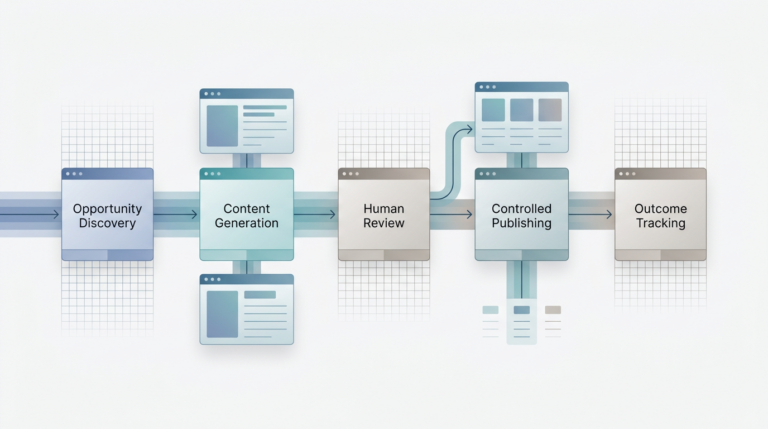
The simplest way to read the RankPilot OS Workflow Object Map is as a high-level sequence of connected concepts: Opportunity, Content Plan, and Brief support planning; Draft, Review, and Publish Job support execution and governance; AI Visibility Run and Outcome Attribution support evaluation after content work moves forward. This article explains the relationship between those objects conceptually, without assuming specific technical behavior, automation, or required system rules beyond the provided RankPilot OS governed SEO/GEO workflow context.

Read article

AI Search Answer Optimization Workflow: How to Prepare Reviewable Content for GEO Without Unsupported Claims

An AI Search Answer Optimization workflow should answer the main question first, then support that answer with only the facts available in the target snapshot, brief, context bundle, and signal pack. For reviewable GEO content, operators should separate supported statements from assumptions, use terminology and signals only as framing guidance, add concise FAQs for expected follow-up questions, and direct readers to relevant existing hub, collection, or product pages only when those pages support the next step.

Read article
Get an SEO / GEO diagnosis